Saturday, July 19, 2014

Everybody’s gotta be somewhere….


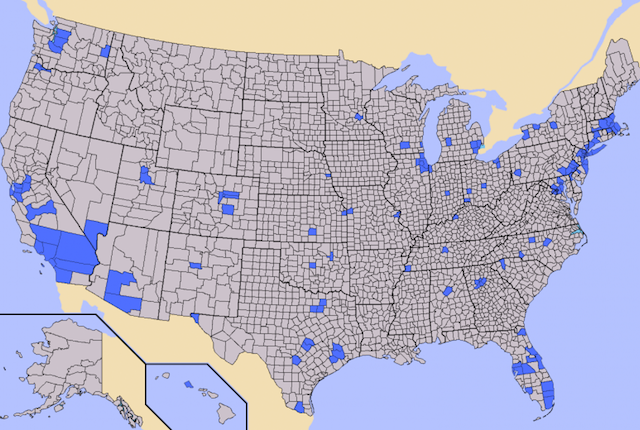
Here's a little picture worth a thousand words.


Forget about wilderness, forget about open prairie, forget about suburban spaces….

There are 3,144 counties in the United States, but half of the population of America lives in the 146 counties colored blue above, mostly concentrated in coastal and lake-front areas, and some widely scattered urban core areas.

In terms of population density, most of America is, more or less, just about empty.


Friday, July 18, 2014

Cost of obesity? $305 billion a year….


America is Fat City.

More than 1 out of 3 adults is obese, and almost 1 out of 5 young people are obese.

More and more Americans are getting fatter every day, and it’s not just their problem.

Researchers at George Washington University estimate that the nation’s cost for obesity—direct medical and non-medical services, lost worker productivity, the impact of disabilities and the social and economic cost of premature deaths—exceeds $305 billion per year.

Why are we still buying and selling sugary drinks and unhealthy snack foods?


Thursday, July 17, 2014

Treasure is cold….


If you’ve never explored a walk in the woods with a small child, read on….

….and be on the lookout for your next chance to dig in the dirt….


“But after three steps into the evergreen shade,
he drops to his knees and begins to furrow.
It’s here, mama, he says. Let’s dig.
I pick up a knobby spruce twig and poke absently at dirt,
 hoping we can start walking again.
 No, mama, like this. With your hands.
I pretend I don’t hear.
He takes my hands in his own, forces them down.
Fine sand runs through my fingers,
old spruce needles swim in it like unstrung commas.
I settle in, sifting and digging up dirt. Making piles.
No mama, deeper than that, he says,
 scratching with his nails into the hardpan.
I dig deeper, past my desire to keep my hands clean.
Past whatever I had set out to do. Treasure is cold
 and filled with crooked things that slip through fingers.”


From "Treasure Hunt in the Woods" by Rosemerry Wahtola Trommer. Published on the poet's blog, November 26, 2007. © Rosemerry Wahtola Trommer.

…and posted July 9, 2014  on the website:   A Year Of Being Here


Wednesday, July 16, 2014

The oldest song in the world


This is unique, and I’m one of the people who takes pains to avoid using the word “unique” whenever it’s not appropriate, which is most of the time….

Here's a link to an audio interpretation of what scholars believe is the oldest song in the world.

OpenCulture.com says it’s a 3,400-year-old Assyrian cult hymn written in the Hurrian language and found on clay tablets discovered in the 1950s in the ancient Syrian city of Ugarit, a port on the eastern end of the Mediterranean Sea.


It’s believed the ancients played this tune on a 9-string lyre.

I don’t think Wynton Marsalis or BeyoncĂ© or anyone else is going to be adding this short piece to a concert repertoire any time soon, but you can give it a try….

You can tap your foot, it’s OK….


Monday, July 14, 2014

BP trashed the Gulf, and still doesn’t want to pay


BP still doesn’t want to pay.

BP is still trying to avoid complying with the court settlement it voluntarily signed, in 2012, to compensate individuals and businesses that suffered losses as a result of the massive 2010 oil spill that contaminated the Gulf of Mexico.

This isn’t a brand-new bombshell—BP has consistently tried to avoid paying claims since its Macondo well exploded and burned in April 2010, killing 11 workers and pouring more than 200 million gallons of oil into the waters of the Gulf. Numerous safety violations caused the spill.

BP argues that some claimants have falsified their losses—doubtless this is true.

But BP has fought the claims administrator at every turn, and has gone back to court numerous times in an effort to avoid paying claims in the way it agreed to pay them in the 2012 court settlement.

Now BP is citing technicalities in asking a federal judge to order many claimants to repay their compensation from BP.

BP's website says: “We are helping economic and environmental restoration efforts in the Gulf Coast as part of our ongoing commitment to the region following the Deepwater Horizon accident in 2010.” This is an example of what Winston Churchill liked to call a “terminological inexactitude”….

It wasn’t an “accident,” and from the gitgo BP has dragged its feet in paying for the damages it caused.

Shame on BP.


Sunday, July 13, 2014

Saturday, July 12, 2014

Meat-eaters hurt the environment


It’s official: eating red meat is a cause of global warming.

Step away from those barbecue tongs!

The average meat-eater in America can take the blame for twice as much global warming as the average vegetarian, according to an Oxford University study published in the journal Climatic Change.

The Oxford dons studied the diets of 60,000 people.
The average American meat-eater puts down 4 ounces of meat a day, and that dietary item is responsible for about 16 pounds of carbon dioxide polluting the atmosphere.

Why? The livestock industry—animals and meat processing—is responsible for about 15% of global carbon emissions.

The study concludes:
"National governments that are considering an update of dietary recommendations in order to define a ‘healthy, sustainable diet’ must incorporate the recommendation to lower the consumption of animal-based products."

Grab a carrot, do something good for the environment.


Friday, July 11, 2014

Book review: Kidding Ourselves: The Hidden Power of Self-Deception


Book review: Kidding Ourselves: The Hidden Power of Self-Deception
Crown Publishers, New York, 2014
260 pages

This is a quotable book. It’s a memorable book.


It’s not an easy read, but the detail is accessible and the observations are shockingly clear, and you’ll want to keep reading it right through to the end.

As Hallinan might say, be optimistic—keep at it. You can do it.

From the author’s introduction: “. . . the real reasons behind our human responses often elude us. In their absence, we drum up plausible explanations, which are frequently mere rationalizations, to explain why we’ve done the things we’ve done . . .”


The eye-opener is that much of this process of  “kidding ourselves” occurs in the subconscious—we don’t know we’re doing it.


For example, like the little engine that could, if we think we can do something we are much more likely to be able to do that thing.

For example, people with power are much more likely to think that they can get away with doing whatever they want, and often they succeed.

For example, if we believe something to be true, we are much more likely to accept confirming evidence, and ignore or not even recognize non-confirming evidence.

For example, try this one: if you’re a person who has some power in the public or private sphere, grab a crayon and write the letter “E” on your forehead, and if you’re a person who is or feels powerless, at work or at home, grab a crayon and write the letter “E” on your forehead—see how that works out (p. 148).

Hallinan doesn’t seem to mention it, but his book puts paid to more or less the entire Western notion of human rationality and The Rational Man.

We aren’t logical, rational, objective beings.

Read the book.


Do you know enough to be a U. S. citizen?


Could you score high enough on the U. S. naturalization test that every immigrant must pass in order to become an American citizen?

1 out of 3 American-born citizens couldn’t do it in a survey conducted by USA Today in 2012, and a year before that Newsweek did a poll, with the same results.


As of March this year, the U. S. Citizenship and Immigration Services Department confirms that 91 percent of immigrants who take the test pass it.

To prepare for the exam, immigrants are given a list of 100 possible questions with the satisfactory answers. 


The test actually consists of 10 questions randomly selected from the list—applicants must get at least six of them correct to pass the test.

Some of the questions are easier than others:

Here are a few samples:

12. What is the “rule of law”?

41. Under our Constitution, some powers belong to the federal government. What is one power of the federal government? 

71. What territory did the United States buy from France in 1803?
How many of the 100 questions can you answer?


Thursday, July 10, 2014

Bicycle what?


Sometimes we tend to think the ancients and the so-called savages and sadly disadvantaged foreigners have strange medical practices, but we don’t have to look elsewhere for doctors gone bonkers….

Vox.com recently offered this little gem about a dark corner of late 19th century American medical care that sort of flourished for a while when bicycling was a new fad and all the rage.


Seems that (almost exclusively male) doctors took great pains to warn women that riding a bicycle could cause “bicycle face.” You know, bicycle face….

Here’s a quote from the Literary Digest in 1895: "Over-exertion, the upright position on the wheel, and the unconscious effort to maintain one's balance tend to produce a wearied and exhausted 'bicycle face . . .'"

And more: the “bicycle face” is “usually flushed, but sometimes pale, often with lips more or less drawn, and the beginning of dark shadows under the eyes, and always with an expression of weariness . . .characterized by a hard, clenched jaw and bulging eyes."

You know, bicycle face….

I guess maybe you had to be a doctor to recognize the symptoms….

And another thing: you have to wonder where women bought those exercise outfits….


Wednesday, July 9, 2014

We’re not getting what we pay for


The United States has the worst quality of health care among 11 Western industrialized nations.

And we have the most expensive health care, by far.

I know you’re not surprised.


The comparisons are from the 2014 report of the Commonwealth Fund, a New York-based foundation that promotes improved health care.

Obamacare is a first step toward improving our national health care and lowering costs.

We need to do better, real fast.

We need to stop paying doctors for doing tests, and start paying them for keeping us healthy.


We need to make sure that everyone pays for health insurance, because in America, like it or not, everyone can get health care (at least in an emergency room) without health insurance. That has to stop.

We need to get our government to negotiate prices with drug companies.


Cost per person for health care in the U.S.:   $8,508

Cost per person in Norway:   $5,669

Cost per person in New Zealand:   $3,182


Tuesday, July 8, 2014

What if it’s not a forecast?


The U.S. economy added 288,000 jobs in June.

A Bloomberg panel of clueless economists made a collective guess-in-advance that the number would be 215,000. They were 25% off the mark. Way wrong, just like most months.

Notice I said "guess," although Bloomberg called it a "survey" and the (always unnamed) economists called it a "forecast."


These economists on the Bloomberg panel are always wrong. Every month. Their average guess is always wrong. Individually, they're mostly always wrong.

Why do Bloomberg and the news media and the cable TV talking heads keep reporting the useless advance guesses of the 51 guessers who are always wrong?

What's the fascination with trying to know the number one week or one day or one hour before the official report, when we all know that it's impossible to reliably forecast it?

The talking heads and the news media report and analyze flawed survey data every day, without caring that the data is flawed.

We should care more, and trust less.


Monday, July 7, 2014

Darn near everybody doesn’t watch Fox News


A new report on prime time TV ratings in the U. S. shows that less than 1% of adults watch Fox news.


Now, relative to MSNBC and CNN, Fox is a sort of powerhouse—the other two cable news channels get way less than half of 1 percent of the adult prime time audience.

But common sense suggests that we just talk about the absolute numbers: there are about 239 million adults in the U. S., and less than 1.6 million of them are watching Fox News after dinner.

Why do the news media and political commentators pay so much attention to the twisted blather that gets dished out non-stop on Fox News?

Why don’t we just call it “Fox News (wink)” and let it go at that….

...and I'm not keen on the garble from Rachel and her buddies, either....


Sunday, July 6, 2014

The wisdom of Oliver Sacks


"I do not think of old age as an ever grimmer time that one must somehow endure and make the best of, 
         but as a time of leisure and freedom, 
                 freed from the factitious urgencies of earlier days, 
free to explore whatever I wish, 
      and to bind the thoughts and feelings of a lifetime together."

American-British neurologist and writer


I feel the energy of this quote from Sacks' piece, "The Joy of Old Age," in the New York Times on July 6, 2013, read it here 

Sacks, who turned 80 last year, of course was aware that his life “is almost over,” and he didn’t shrink from acknowledging the physical and health realities that alter life as we get older.

I am drawn to his outlook because it elevates one’s willingness to make a life, even make a new life, at whatever age.

Sacks offers one recipe for giving full voice to “the thoughts and feelings of a lifetime.”


I think Walt Whitman heard the same drummer:

“I celebrate myself, and sing myself . . .”


Kurt Vonnegut's homework assignment

Copyright © Richard Carl Subber 2014 All rights reserved.


Saturday, July 5, 2014

Does the “middle class” still exist?


I wonder if our standard concept of the “middle class” still has any meaning?

You know, the idea of the great middle, the backbone of society and the economy, the people who live in decent suburban homes, the folks who do the work of America, the family types who work hard  to give their kids a better life than they had….

Seems like every economic analysis I see these days suggests that everybody who isn’t in the top 10% or the top 1% or the top 1% of the top 10%, in terms of wealth and income, is just struggling to keep up while incomes and wealth continue to fall.

Yahoo.com reports that some standard benchmarks of financial well-being aren’t really useful anymore because the very, very wealthy are skewing the averages and hiding the fact that most folks are slipping lower on the financial benchmarks.

Yeah, the “average” American earns $44,000 and saves about 4% of income, and the “average” household has a net worth of $710,000.


But the averages are severely skewed by the very wealthy.


For instance, the top 1% of earners save 38% of their income. Try it: don’t spend 38% of your next paycheck, and that’s 38% of gross, not take-home, so you’re probably going to have to put aside half of your take-home pay. Try it.

Median household income—the mid-point of all households, which isn’t skewed by high earners—now stands at about $53,000, and that’s 7% LOWER than it was 14 years ago.

This is part of the explanation for our continuing, go-slow economic recovery, namely, that way too many folks in America aren’t recovering.


Friday, July 4, 2014

“. . . that some men are created equal . . .”


A patriotic salute to our country and to all Americans on the 4th of July!

And now just a little dose of reality to leaven our celebration of the Declaration of Independence:

You probably know this, but let’s mention it anyway—those patriotic Americans who signed the Declaration really didn’t mean it when they said “all men are created equal.”

They certainly weren’t thinking about all of the poor, landless and otherwise disadvantaged white males who didn’t qualify in the various colonies to vote.

They certainly weren’t thinking about the roughly 600,000 slaves in the brand new United States. In fact, many of the signers owned slaves, and Jefferson’s draft paragraph decrying the slave trade was stricken from the officially adopted version of the Declaration.

They certainly weren’t thinking about Native Americans who lived in and west of the British colonies. The First Peoples were not mentioned in the Declaration in any positive way.

They certainly weren’t thinking about women. The prevailing mindset of the time, among men, really didn’t recognize any political role or rights for women. Abigail’s lectures to John Adams were marvelous; also, they were trivial marginalia in the great scheme of things during the Revolution.


Thursday, July 3, 2014

Going deeper than “Republican vs. Democrat”….(part 1)


If you think about it for at least 4 seconds, you know this is true: the “Republican” and “Democrat” categories are way too big to adequately explain differences on just about every political dispute.

You know this is true if you think about every one of your Democratic (or Republican) friends: they don’t fit in the same bucket on every issue, not by a long shot.

I’m really serious about digging into a new report from the Pew Research Center on the disparate political ideologies of Americans.

This report got a little airtime on Vox.com, but I didn’t see any mention of it anywhere else.

There’s really nothing in it that can be easily reduced to a talking head sound bite, maybe that’s why it wasn’t reported widely….maybe it’s not simplistic enough for our shallow, staccato, stentorous, soundbite-ish news cycle….

Here’s a sample:
Andrew Prokop at Vox.com says:

“Pew argues that we should think of the Democratic coalition as having a core of solid liberals — plus two other somewhat more moderate clusters that agree with liberals on most issues, but have very different views on a few. The first of these clusters is ‘The Next Generation Left.’ Though the group skews younger than any other group in the survey, don't interpret it as representing the views of young liberals — only 33% of the group is under 30 years old. Instead, it's a group of mostly-Obama supporting people who are liberal on most economic, social, and foreign policy issues — but seem to have some very different views on race, the safety net, and how fair America is.”

For instance, the “Next Generation Left” massively voted for President Obama in 2012, but this segment departs from the generally liberal Democratic outlook on the subject of racial discrimination and racial equality—only a small minority of them think that “racial discrimination is the main reason many black people can’t get ahead.”

There’s a lot of meat and a lot of provocative detail in this report, take a look.


Wednesday, July 2, 2014

Companies are deliberately not hiring


There are more than 10 million Americans looking for a job, but American companies are holding on to their cash and not doing much hiring.

WashingtonPost.com recently noted that companies are posting lots of jobs, and doing lots of interviews with applicants, but the actual hiring process is slow, frustrating, and often terminated without an actual hire.

You probably know someone who was called back for seven interviews for a choice job, and then never heard from the company again.

What’s going on here? American corporations have more than $2 TRILLION in cash on hand.

They’re not making much interest on it…..you know what interest rates are like these days.

There really is no other explanation except this one: companies are deliberately not using their hoard of cash to expand their business operations and hire more people.

Are they waiting for a new Republican president?

Might be a long wait….


Tuesday, July 1, 2014

Who would pay $225,000 to hear Hillary speak?


Well, the students at University of Nevada, Las Vegas, aren’t in that category.

In fact, they're ripped that their college (or some UNLV benefactor) IS willing to fork over nearly a quarter of a million dollars to bring Hillary Clinton to the campus for a speaking engagement this October.


I get it, I get it, in fact I’m more or less OK with the concept that if somebody is willing to pay anybody $225,000 to “stop by our campus and give a speech,” well then, that’s the market price. It’s not illegal for Hillary to take that wad of cash.

I wouldn’t chip in to bring her to my campus, but that’s another story….

What really burns me up is that, apparently, no one in a leadership position at University of Nevada, or on the UNLV board of trustees, was willing to step up to the mike and say “No, this is a bad idea,” when the university is planning to raise tuition by 17 percent over the next four years.

Shouldn’t the college’s money, or the donor’s money, be used for a better purpose?


Monday, June 30, 2014

Binky-fication....


If you’re a parent or a grandparent, you know what I’m talking about:

The binky, that thingie that seemingly calms the infant, the squirmer, the squaller, for a while at least….

You probably don’t know how it got its name.

Originally called a “baby comforter,” the pacifier as we know it was invented in 1901 to replace the rags, wooden beads, and “gum sticks” made of stone, bone or coral, all the stuff that anxious parents had been using since at least the 16th century.


In the 1940s, a very popular brand was manufactured by the Binky Baby Products Company of New York, and….you guessed it….


By the way, some experts advise that you stop binky-fying your child at the age of 3.


Sunday, June 29, 2014

“I can see my neighbor’s chimney smoke….”


“I can see my neighbor’s chimney smoke….”

If you’re of the committed liberal political stripe, you could probably say that with some satisfaction.

If you’re strapped in to conservative political views, not so much….


The Pew Research Center says 8 out of 10 “consistent liberals” say they’d like to live in a community with smaller houses and cozier lot sizes, and with schools and restaurants within walking distance….that is, life on a neighborly scale….

Only 2 out of 10 “consistent conservatives” say they’d go for that.

OK, puh-tay-toe, puh-tah-toe, you know….

Still, the neighborly approach really appeals to me.